


Your Next Store
Released 7mo ago
Generative
|Workflow
|E-commerce
|Retail
yns.store
yns.store
yns.store
The Vision: Why Your Next Store Exists
Your Next Store is the generative design engine for digital retail. It solves the primary bottleneck of traditional e-commerce: the high friction, technical complexity, and time-intensive nature of moving from a business concept to a live, aesthetic storefront. By replacing complex drag-and-drop builders with a conversational interface, it democratizes high-end web design. Here are specific personas who benefit most:
- DTC Entrepreneurs: Founders looking to launch niche brands (skincare, apparel, specialty coffee) without hiring a developer.
- Marketing Agencies: Teams needing to rapidly prototype "burner" stores or landing pages for specific product drops or seasonal campaigns.
- Boutique Retailers: Small business owners who want a "Scandinavian" or "High-end" aesthetic without the five-figure price tag of a custom agency build.
The Engine: How the "Secret Sauce" Works
AI Technology: Generative (Prompt-to-UI) and Multimodal (Image-to-Style).
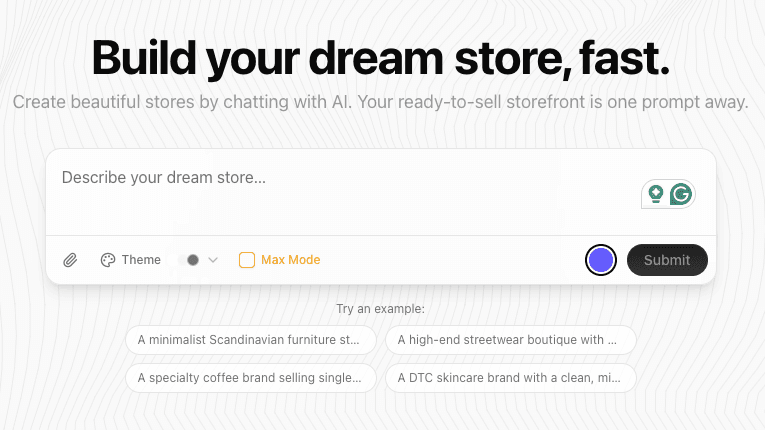
Input-Output Loop: The user provides a descriptive text prompt (e.g., "A minimalist furniture store with oak finishes") or uploads reference images; the AI then generates a complete, themed storefront including layout, color palettes, and typography.
Innovation highlights:
- Max Mode: An advanced generation state that likely leverages higher-compute models for more complex layout logic and creative asset placement.
- Contextual Theming: The engine understands industry-specific aesthetics, such as "moody neon" for streetwear or "warm editorial" for coffee brands.
- Next.js Infrastructure: Built on a high-performance stack (Vercel/Next.js) ensuring that the generated stores are not just pretty, but technically optimized for speed and SEO.
The Toolkit: Capabilities & Connectivity
Flagship Features:
- Conversational Editor: A central chat interface that allows users to refine their store design through iterative feedback.
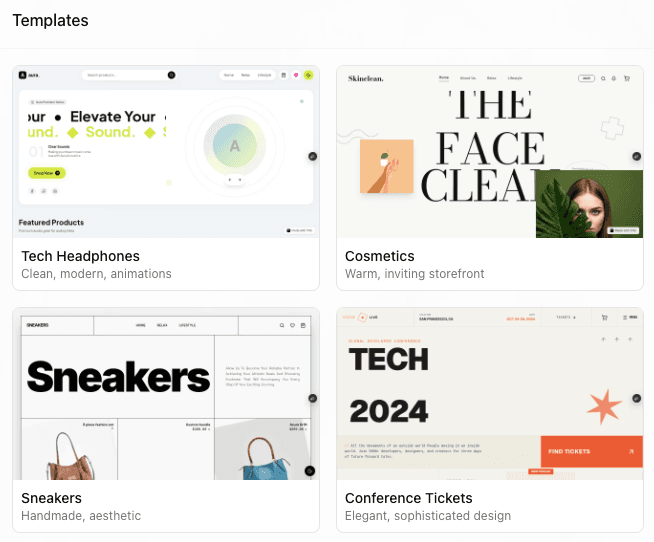
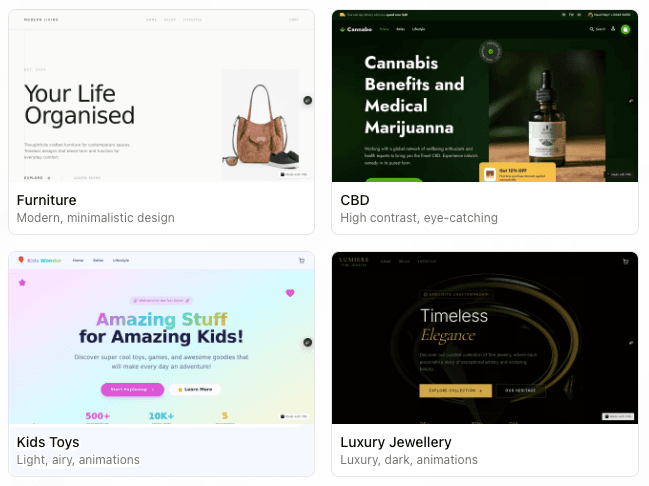
- Industry-Specific Templates: Pre-configured starting points for diverse sectors including CBD, Luxury Jewelry, Pantry/Sauces, and Gaming Setups.
- Visual Style Controls: Real-time theme switching and palette adjustments that allow for granular control over the AI's creative output.
Integrations: Vercel (Deployment), Next.js (Framework), and standard e-commerce payment/inventory connectors (implied by the "ready-to-sell" status).
The Proof: Market Trust
Status: Currently operating as a high-performance SaaS platform leveraging the Vercel ecosystem for global scalability.
- Diverse Template Library: Over 10+ distinct industry categories ranging from tech to artisan sneakers.
- Modern Tech Stack: Utilizes the latest Next.js 15/App Router architecture for sub-second page loads.
- Zero-Code Barrier: Successfully abstracts the entire frontend engineering process into a single text area.
The Full Picture: Value & Realism
| Pros | Cons |
|---|---|
| Extreme Speed: Go from idea to a professional-grade storefront in under 60 seconds. | Backend Depth: While the frontend is instant, complex custom logic (e.g., unique loyalty programs) may require manual intervention. |
| Aesthetic Consistency: AI ensures that fonts, colors, and spacing remain professional across all pages. | Platform Lock-in: Users are typically tied to the platform's specific generative ecosystem for future updates. |
Pricing
- Starter: Ideal for individuals testing a single product concept with basic AI generation.
- Pro: Includes "Max Mode" access, custom domains, and advanced template libraries for growing brands.
- Enterprise: Tailored for agencies managing multiple client stores with high-volume traffic requirements.
Frequently Asked Questions
Q1: Can I change the design after the AI generates it?
A: Yes, the platform allows for iterative chatting to refine specific elements like colors, themes, and layouts.
Q2: Is the store mobile-responsive?
A: Absolutely. The underlying Next.js framework ensures all generated stores are fully responsive and optimized for mobile shopping.
Q3: Do I need to know how to code?
A: No. The entire value proposition is built on a "zero-code" experience where your only tool is your ability to describe your vision.