


Sonarly
Released 7mo ago
Agentic
|ML
|Engineering
|Operations
sonarly.com
sonarly.com
sonarly.com
The Vision: Why Sonarly Exists
Sonarly is the autonomous site reliability engineer for production environments. It addresses the critical bottleneck of "alert fatigue" and the time-consuming process of manually reproducing production bugs. By combining error tracking with deep execution context, it moves beyond simple monitoring into active resolution. Here are specific personas who benefit most:
- On-Call Engineers: Who need to quickly filter noise from critical production incidents.
- Frontend Developers: Who struggle to reproduce "it works on my machine" JavaScript errors occurring in the wild.
- DevOps Teams: Seeking to reduce Mean Time to Resolution (MTTR) through automated root cause analysis.
The Engine: How the "Secret Sauce" Works
AI Technology: Agentic.
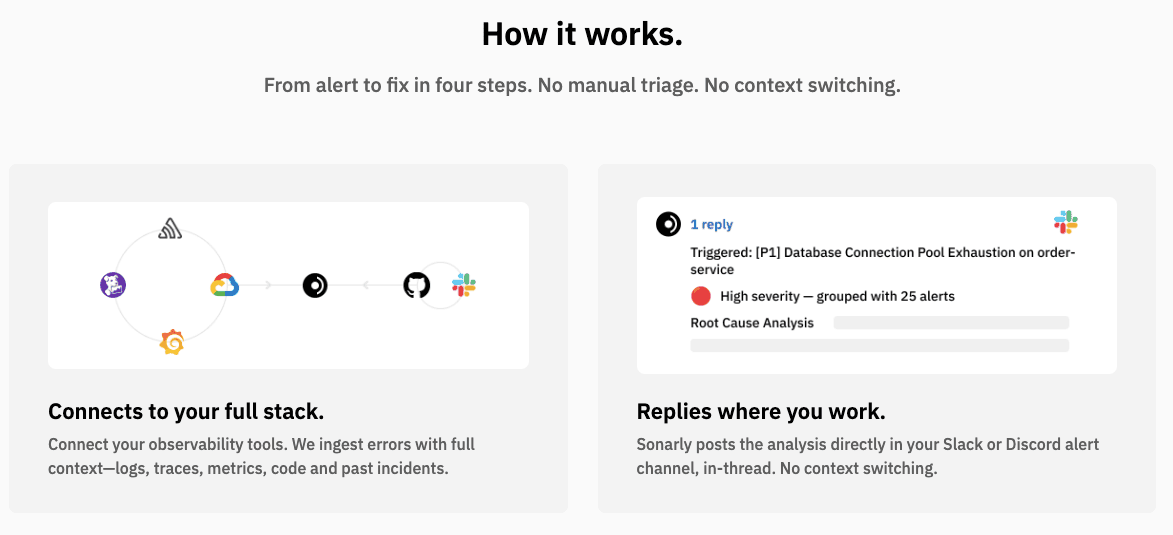
Input-Output Loop: The system ingests production alerts, error logs, and user session replays as input; the AI agent then processes this context to output triaged reports and specific code fixes.
Innovation highlights:
- Contextual Triage: Unlike standard error trackers, Sonarly understands the state of the production system at the time of failure.
- Session Replay Integration: It uses visual and state-based session recordings to "see" what the user saw, feeding this data into the AI reasoning engine.
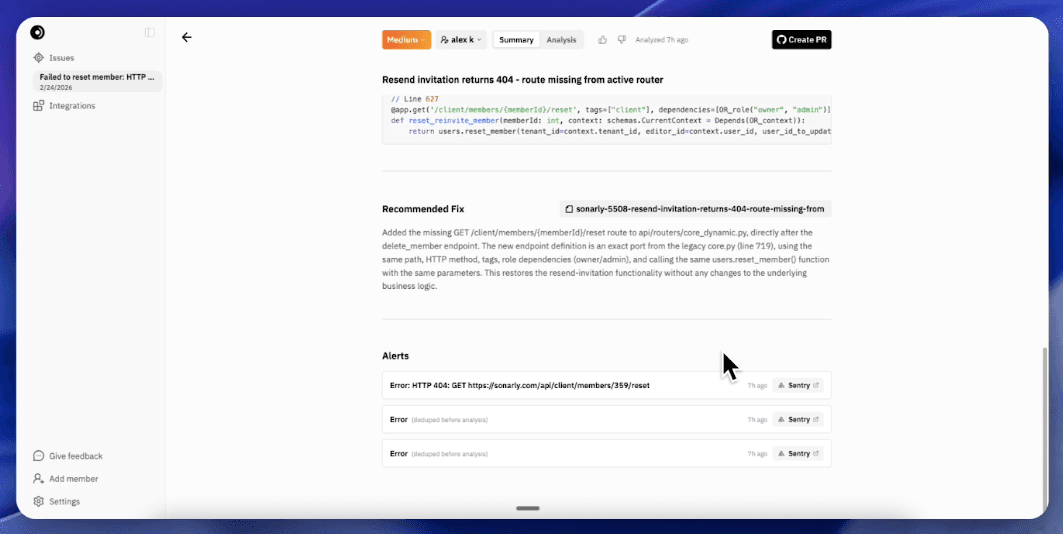
- Autonomous Debugging: The agent doesn't just report errors; it attempts to identify the specific line of code responsible and suggest a resolution.
The Toolkit: Capabilities & Connectivity
Flagship Features:
- Automated Incident Triage: Focuses on reducing cognitive load by prioritizing bugs based on actual impact and system context.
- AI-Powered Bug Fixing: Focuses on developer velocity by providing ready-to-review fixes for production incidents.
Integrations: JavaScript environments, frontend monitoring stacks, and compatibility with AI coding assistants like Cursor and Claude.
The Proof: Market Trust
Status: Early-stage innovator (Currently offering entry-level access for production debugging).
- Full-Stack Visibility: Designed to handle complex JavaScript and frontend error tracking.
- Developer-Centric: Built to complement modern AI-first development workflows.
- Production-Ready: Focused specifically on the "Prod" environment rather than just local development.
The Full Picture: Value & Realism
| Pros | Cons |
|---|---|
| Drastically reduces time spent on manual bug reproduction. | Requires integration into production environments which may involve security reviews. |
| Provides high-fidelity context that standard logs often miss. | AI-generated fixes still require human oversight to ensure zero regressions. |
Pricing
- Free/Beta Tier: Currently listed with a base price of $0 for initial adoption and testing.
- Pro Tier: Targeted at scaling teams requiring higher volume alert processing.
- Enterprise: Custom solutions for organizations with strict security and compliance needs.
Frequently Asked Questions
Q1: How does Sonarly differ from standard error monitoring like Sentry?
A: While Sentry records errors, Sonarly acts as an agent to triage those errors and suggest actual code fixes using the full context of the incident.
Q2: Is it safe to let an AI access production data?
A: Sonarly is designed to ingest logs and session data to provide insights; code changes are typically presented as suggestions for developers to review before deployment.
Q3: Does it support backend languages?
A: The current focus is heavily on JavaScript and frontend production systems, where session context is most vital for debugging.