


Shepherd
Released 1d ago
Analytics
|Productivity
|Education
|Operations
shepherdtime.com

shepherdtime.com
shepherdtime.com
The Vision: Why Shepherd Exists
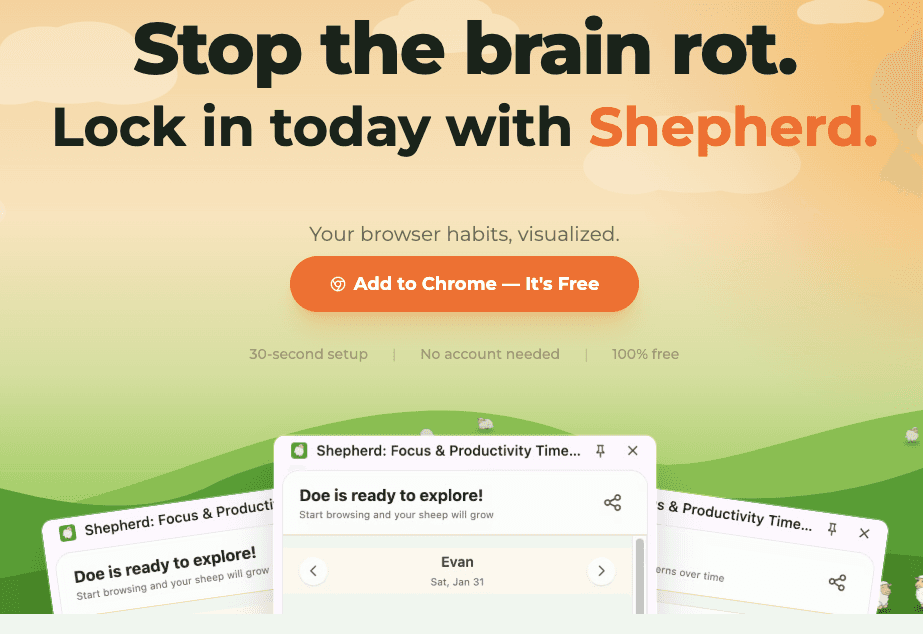
Shepherd is the accountability mirror for the modern web browser. It addresses the core bottleneck of "digital drift"—the unconscious transition from productive work to mindless doomscrolling. By providing a transparent, often blunt assessment of how time is spent online, it transforms abstract browsing habits into actionable data. Here are specific personas who benefit most:
- Students: Those needing to maintain focus during research sessions and minimize distractions from social media.
- Remote Professionals: Individuals working without physical oversight who want to optimize their deep-work windows.
- Self-Improvement Enthusiasts: Users looking to "gamify" their discipline by competing against their own past performance or peers.
The Engine: How the "Secret Sauce" Works
AI Technology: Analytics and Predictive Scoring.
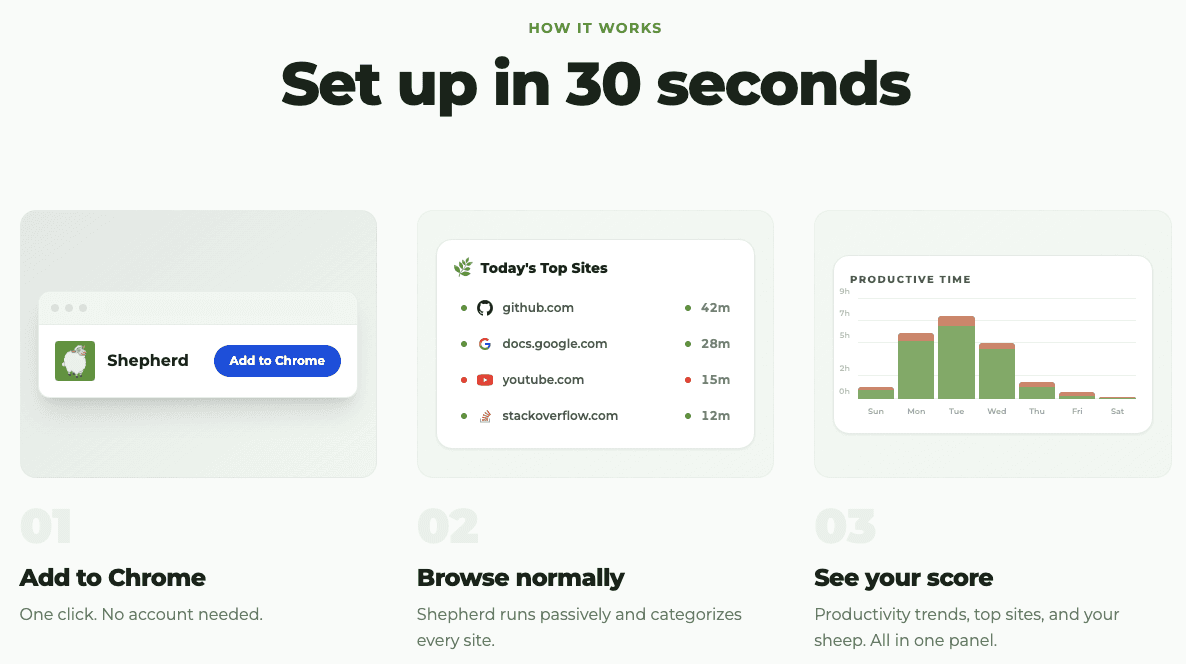
Input-Output Loop: The system monitors active browser tabs, URLs, and user engagement levels (input) to generate a real-time productivity score and a "Brain Rot" rating (output).
Innovation highlights:
- Idle Detection: Sophisticated monitoring that distinguishes between active work and tabs left open while the user is away.
- Session Recording: A visual audit trail that allows users to review exactly where their focus deviated during a work block.
- Manifest V3 Compliance: Built on the latest Chrome extension architecture for optimized performance and security.
The Toolkit: Capabilities & Connectivity
Flagship Features:
- Brain Rot Score: A viral, high-impact metric that categorizes low-value browsing to shock users into better habits.
- Social Leaderboards: A competitive layer that allows users to compare productivity scores with friends or colleagues, leveraging social pressure for positive outcomes.
Integrations: Google Chrome, Chromium-based browsers (Edge, Brave), and Social Sharing APIs.
The Proof: Market Trust
Status: Early-stage growth (Stanford-incubated).
- Academic Pedigree: Developed by a team out of Stanford University, applying behavioral science to digital productivity.
- Viral Growth: Positioned as a "RescueTime alternative" with a focus on Gen-Z and modern web aesthetics.
- Zero-Cost Entry: Currently offered as a free tool to maximize user acquisition and data refinement.
The Full Picture: Value & Realism
| Pros | Cons |
|---|---|
| High engagement through gamification and "Brain Rot" branding. | Privacy-conscious users may be wary of session recording features. |
| Completely free to use with a lightweight browser footprint. | Currently limited to Chrome/Chromium ecosystems. |
Pricing
- Free Tier: Full access to the Chrome extension, productivity tracking, and social leaderboards.
- Community Access: Open access to the "Brain Rot" rating system at no cost.
- Enterprise/Pro: (Potential future roadmap) Advanced team analytics and deep-dive reporting.
Frequently Asked Questions
Q1: Is my browsing data being sold?
A: The tool is built by Stanford developers with a focus on personal productivity; users should review the privacy policy regarding how session data is stored.
Q2: How does it define "Brain Rot"?
A: It categorizes sites known for infinite scrolling and low-information density (like TikTok or YouTube Shorts) as high-rot activities.
Q3: Does it work on mobile?
A: Currently, Shepherd is optimized as a Chrome Extension for desktop browsing environments.