


Lightning Rod
Released 6mo ago
ML
|Agentic
|Research
|Operations
lightningrod.ai
lightningrod.ai
lightningrod.ai
The Vision: Why Lightning Rod Exists
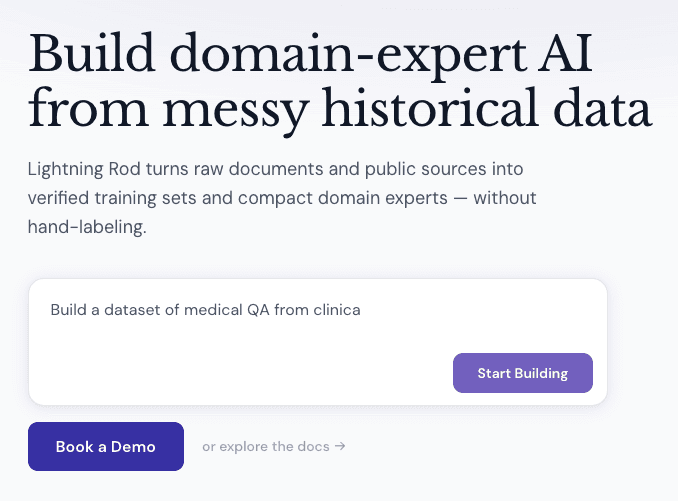
Lightning Rod is the automated data factory for domain-expert AI. It addresses the primary bottleneck in AI development: the transition from raw, unstructured historical data to high-quality, labeled training sets. Instead of relying on slow and expensive human labeling, the platform uses real-world outcomes to verify data. Here are specific personas who benefit most:
- AI Engineers: Who need to fine-tune models on niche domain data without waiting weeks for manual annotations.
- Data Scientists: Who require high-confidence evaluation pipelines grounded in ground-truth historical outcomes.
- Domain Experts: In fields like finance, law, or medicine who want to build "compact experts" from their own proprietary document silos.
The Engine: How the "Secret Sauce" Works
AI Technology: Agentic and Reinforcement Learning (RL) focused.
Input-Output Loop: Users provide raw documents, public data feeds, or a descriptive prompt; the AI agent then generates questions, resolves outcomes based on historical truth, and outputs verified training sets ready for fine-tuning.
Innovation highlights:
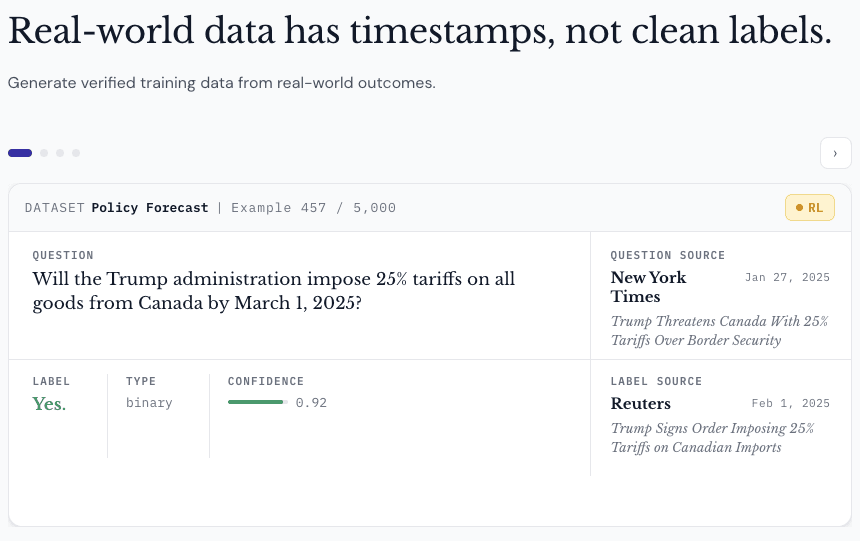
- Future-as-Label Methodology: A novel research approach that uses subsequent historical events to automatically label past data points, ensuring 100% ground-truth accuracy.
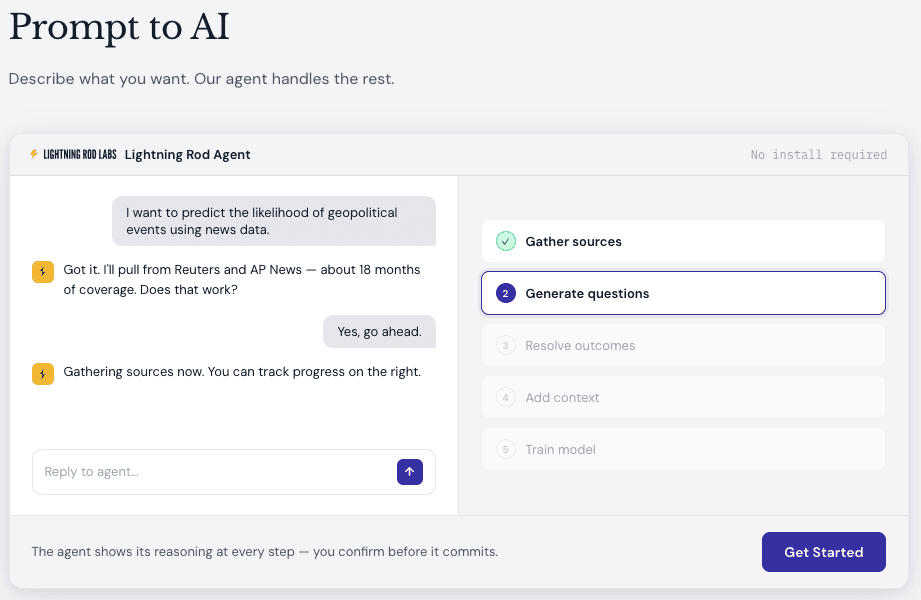
- Agentic Reasoning: The system uses an AI agent that shows its reasoning at every step, allowing users to confirm logic before the dataset is committed.
- Automated Provenance: Every generated Q&A pair is automatically linked to source documents with full citations, eliminating the "black box" nature of synthetic data.
The Toolkit: Capabilities & Connectivity
Flagship Features:
- Lightning Rod Agent: A conversational interface where users describe the dataset they want, and the agent handles source gathering and question generation.
- Python SDK: A developer-first toolkit that allows teams to build data pipelines programmatically using simple commands like pipeline.run().
Integrations: GitHub, HuggingFace, SEC Filings, Wikipedia, and various Global News Feeds.
The Proof: Market Trust
Status: Enterprise-ready, trusted by government agencies, startups, and private equity firms.
- #1 Ranking: Their Foresight-32B model ranked #1 on the UChicago ProphetArena Sports leaderboard, outperforming GPT-5.2.
- Top 5 Performance: Ranked in the top 5 on ForecastBench, beating frontier models like Gemini 3 Pro and Claude 4.5.
- Efficiency Metric: Users report generating 10,000 high-quality, citable QA pairs in just a few hours.
The Full Picture: Value & Realism
| Pros | Cons |
|---|---|
| Eliminates the need for manual hand-labeling, saving weeks of human labor. | Requires a sufficient "historical tail" of data to verify outcomes effectively. |
| Provides full transparency with citations for every data point generated. | High-performance features may require a learning curve for non-technical users. |
Pricing
- Free/Trial: Sign-up available via the web dashboard for initial exploration.
- Developer: Access via Python SDK and GitHub for custom pipeline builds.
- Enterprise: Custom pricing available via Book a Demo for government and large-scale corporate needs.
Frequently Asked Questions
Q1: How does it ensure the data is accurate?
A: It uses a "Future-as-Label" methodology, meaning it looks at what actually happened in historical records to verify the answers it generates.
Q2: Do I need to install complex software?
A: No, the agent is accessible via a web interface, and developers can use the lightweight Python SDK.
Q3: Can it work with my private documents?
A: Yes, it is designed to turn messy internal historical documents into structured training data alongside public sources.